Dave Cacciatore, Jr., presented prosecution witnesses and exhibits concerning the incident's chronology, Boone's recorded accounts, and Torres's death inside the suitcase. In closing, he argued that the confinement and video evidence supported second-degree murder and that battered spouse evidence did not eliminate self-defense's imminent-danger requirement.
ProsecutionOffice of the State Attorney
Dave Cacciatore, Jr.
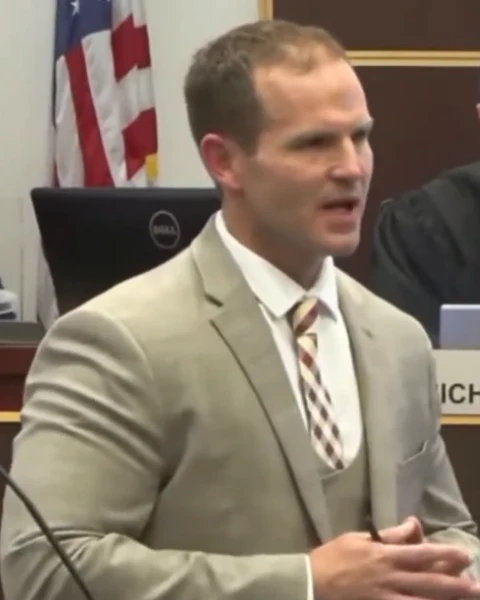
Dave Cacciatore, Jr. is an Assistant State Attorney with the Office of the State Attorney, representing the State of Florida in the prosecution of Sarah Boone.
Appeared2024 Criminal Trial
848 lines·52 proceedings·1 mention
About
Dave Cacciatore, Jr., developed the prosecution's account through witness examinations, recorded statements, physical exhibits, and medical testimony, then argued that Torres's confinement in the suitcase defeated Boone's claim of self-defense. During jury selection, he also read potential State witness names for familiarity screening.
On Day 5, Cacciatore used testimony about calls and sounds to establish the sequence surrounding the incident. He asked Juan Torres about voice identification and background yelling without recounting Jorge's statements. His examinations of neighbors Vincent Battaglia and Brandon Moats developed accounts of arguing and a later loud noise; on redirect, Battaglia placed the noise around 11:00 or 11:15. With Brian Boone, Cacciatore elicited approximate call times and repeated advice to call 911, including testimony that Sarah had not called when Brian arrived. Abraham Moreno recounted her explanation involving hide-and-seek, teaching Torres a lesson, and remembering nothing further until morning.
Cacciatore introduced recordings and physical evidence through authentication testimony. Devin Jamro authenticated Publix receipts and surveillance, and Joan Williams authenticated the 911 recording; those exhibits were admitted without objection. Kayla Rodriguez and John Martinez authenticated body-camera footage, while Melissa Roughgarden identified scene photographs, wine bottles, a baseball bat, and the suitcase, describing its condition and dimensions. During Roughgarden's cross-examination, Cacciatore objected that she had not had an opportunity to answer a question. His redirect addressed photographic coverage and whether she had documented wall damage.
On Day 6, Cacciatore examined medical examiner Sara Zydowicz about positional asphyxia with environmental suffocation, blunt-impact injuries, and limits on forensic timing. On redirect, he proposed an approximately five-hour confinement estimate based on alcohol dissipation. Zydowicz qualified that estimate rather than confirming a fixed duration and explained why a zipper opening would not necessarily provide sufficient oxygen.
Through Detective Chelsey Koepsell, Cacciatore introduced Boone's on-scene interview and developed testimony about obtaining phone evidence after discovering the suitcase videos. Koepsell also authenticated the February 25 interview, which the court admitted over objection. Cacciatore stated that an edited version had been furnished to the defense on the first day of jury selection. The jury watched investigators challenge Boone's explanations while she denied intent; those exchanges were recorded interviews, not questions Cacciatore put to her in court.
In closing on Day 10, Cacciatore connected the homicide instructions to the suitcase, the death stipulation, Boone's statements, and video evidence. He argued that second-degree murder did not require intent to cause death and that voluntary intoxication was not a defense. Owens objected during his initial-aggressor discussion, and the court overruled the objection. Cacciatore then argued that battered spouse evidence could inform the assessment of imminent danger but did not remove that requirement. He challenged Boone's self-defense account by contrasting the suitcase videos, including the change in Torres's voice, and asked the jury for a second-degree murder verdict.
Trial Record (52)
No proceedings match this filter.