William R. Jay presented the prosecution's argument that Sarah Boone's continued confinement of Jorge Torres in the suitcase was punishment rather than justified defensive force. His cross-examinations challenged Boone's account and the basis of the defense experts' assessments, while his rebuttal presentation distinguished battered spouse syndrome from legal justification.
ProsecutionOffice of the State Attorney
William R. Jay
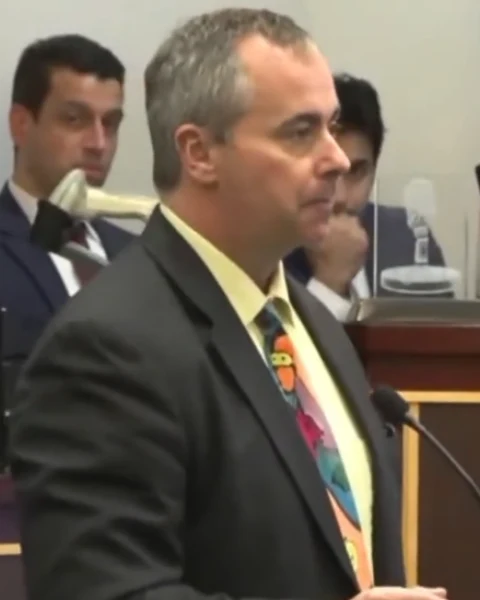
William R. Jay is an Assistant State Attorney with the Office of the State Attorney. He represents the State of Florida in its prosecution of Sarah Boone.
Appeared2024 Criminal Trial
2,894 lines·170 proceedings·3 mentions
About
William R. Jay presented the prosecution's argument that Boone confined Jorge Torres to punish him rather than use reasonable defensive force. During jury selection, he explored whether jurors could separate personal reactions from Boone's state of mind and evaluate conflicting accounts, including expert testimony. In opening, he previewed the suitcase videos as evidence jurors could assess directly, while cautioning that the identity of each phone's user was unknown for the text messages.
Jay sought an advance ruling on whether Boone's proposed account supported self-defense and challenged proposed opening displays. The court barred instruction boards, injury photographs, and suitcase-video playback during opening; on Day 7, it found an overt act established and conditionally allowed prior-violence and battered spouse evidence. Jay also defended digital exhibits through metadata, contextual conversations, and anticipated extraction testimony, conceding that foundation remained necessary. The court rejected broad objections while preserving trial objections. He requested written documentation of oral rulings for appellate review.
Through direct examination, Jay developed the scientific and digital evidence underlying the prosecution's presentation. Meredith McCaskill reported no foreign DNA results from either person's fingernail samples and explained her technical review of another analyst's work. Junella Uadan explained phone extraction methods, authenticated materials admitted as State's Exhibits 16 and 17, and reviewed messages and video timestamps before the State played two extracted videos.
On cross-examination, Jay challenged Boone's memory and police accounts and examined the suitcase opening and bat use. Boone admitted leaving Torres inside without helping him escape; the court allowed the disputed demonstration. His questioning of officers concerning earlier domestic calls tested injury recollection and the information used to reach investigative conclusions, rather than establishing a comprehensive account of prior violence. He also challenged neighbor Pearl Walker's observation limits: she could not date the injuries she remembered and inferred possible arguments from barking dogs.
Jay tested the basis of the defense's expert evidence. Michael Brannon discussed collateral sources and alternative explanations involving alcohol, personality traits, prior diagnoses, and symptom timing, without making a case-specific finding. The court allowed Jay's disputed hypothetical based on anticipated rebuttal videos, subject to a possible later request to strike. Julie Harper acknowledged that she had not reviewed extracted texts or prior body-camera footage and had never asked which words prompted Boone's reported anger. She confirmed Boone's account of intending to leave Torres confined briefly to convey how choking felt. The court struck one question characterizing Boone's recorded statement, reminded jurors that questions are not evidence, and restricted questions about jail medical records.
In rebuttal, Jay examined Tonia Werner about diagnostic limits and the relationship between Boone's reported conduct and perceived imminent harm. A disclosure dispute produced a finding of an inadvertent but substantial discovery violation and a court-supervised deposition; the court declined to strike Werner. Her redirect distinguished battered spouse syndrome from justification. Jay also published recordings containing conflicting violence allegations and selected extraction messages about relationship conflict, abuse allegations, and reconciliation. These were recorded statements, not court findings. On Day 10, he opposed a misdemeanor culpable-negligence instruction, but the court included it. His rebuttal closing challenged Boone's account and Harper's follow-up inquiry, arguing that continued confinement and the initial-aggressor instructions defeated self-defense despite battered spouse syndrome.
Trial Record (170)
No proceedings match this filter.